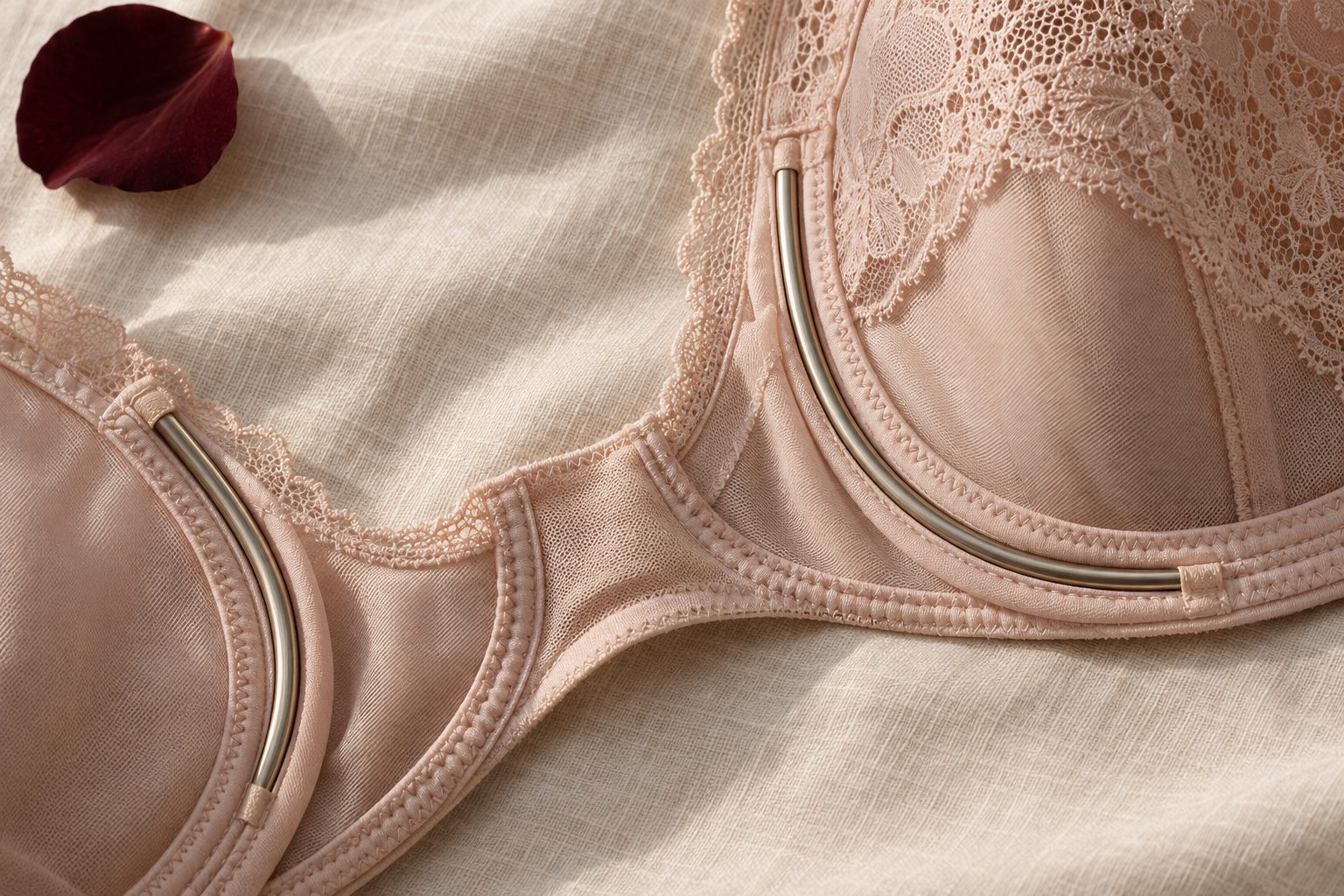
An underwire that digs into your ribs, presses on breast tissue, or pokes through the fabric is a fit signal, not a design flaw. The wire is a rigid U-shape, and it only feels comfortable when it follows the outline of your breast root exactly. When it does not, the pressure concentrates on a small area and you feel it all day.
There are five usual causes. Each has a different fix, so it is worth identifying yours before you buy anything.
1. The cup is too small
The most common cause. If the cup cannot contain your breast, the wire sits on top of breast tissue at the side and along the bottom instead of around it. Tissue under a rigid wire is exactly what produces that sharp, bruised ache by mid-afternoon.
Signs: redness or a mark along the side of the breast, wire resting on tissue rather than against the ribcage, overflow at the top or side of the cup.
Fix: go up a cup size with the same band. If the band then feels loose, sister size down in the band and up again in the cup.
2. The wire is too narrow for your breast root
Every bra has a fixed wire width. If your breast root is wider than the wire, the ends of the U press into the side of your breast, usually near the armpit. This is very common on wider ribcages and on anyone who has been sized by adding inches to the underbust measurement.
Signs: pressure at the outer edge, wire ends sitting on tissue, marks under the arms.
Fix: look for brands and styles described as having a wider wire or a fuller-coverage cut. Going up a cup size also widens the wire, which is often enough.
3. The band is too tight
A band that is too small pulls the whole bra inward, which drives the wire into your ribs at the front and sides. It also makes the wire sit lower than it should.
Signs: deep red marks under the bust that last after you take the bra off, difficulty taking a full breath, wire sitting below the crease.
Fix: go up a band size and down a cup size to keep the cup volume. If you are between sizes, a bra extender is a reasonable temporary answer while the band relaxes.
4. The wire has been bent or washed badly
Wires bend when a bra goes through a spin cycle, when it is folded in half for storage, or when it is put on by twisting it around the body. Once the U-shape is distorted, it presses in places it was never designed to touch.
Signs: the wire no longer lies flat on a table when you take the bra off.
Fix: you can sometimes bend it back by hand against a flat surface, working gradually. If the wire has started to escape the channel, the bra is finished. Our guide to washing and storing bras covers how to avoid this.
5. The style does not suit your shape
Plunge bras have short wires that sit lower at the centre. Balconette styles have wide-set straps and a shallow upper cup. Full-cup styles have tall wires that can press into the ribcage if your torso is short. A style mismatch will dig in even in the correct size.
Fix: if the same size digs in across multiple styles, you may simply be someone who does better without underwire. That is not a compromise on support. Modern wireless bras use structured cups, wide bands, and bonded edges that hold shape well, and for many women they are more comfortable for a full day of wear.
When the problem is not the bra
If the pain continues after you take the bra off, if there is broken skin, a persistent lump, or pain that is not clearly linked to the wire’s position, stop treating it as a fitting issue and speak to a doctor. The NHS and Mayo Clinic both publish guidance on breast pain, and a fitting problem is only one possible explanation. This article is about bra fit, not medical advice.
A two minute test before you buy another underwire
- Put the bra on and fasten it on the loosest hook.
- Lean forward, gather your breast tissue into the cup with your hand, and stand up.
- Run a finger along the wire. It should be under breast tissue, not on it, along its whole length.
- Check the centre gore. It should touch your sternum.
- Take five deep breaths. If you cannot fill your lungs comfortably, the band is too tight.
If the wire passes all of that and still digs in, the wire shape is wrong for you and no size change will fix it. That is the point at which wireless becomes the better answer rather than a fallback. Our guide to wireless versus underwire bras compares the two honestly, and if you have already decided, the best bras without underwire roundup covers specific options.
Questions we get asked
Can you remove an underwire from a bra?
You can cut a small opening at the wire end and pull it out, but the bra loses its structure and the channel will show. It is worth doing on a bra you otherwise love if the wire has broken, not as a way to convert a bra into a wireless one.
Why does the wire poke out through the fabric?
The wire tip wears through the channel after repeated washing and bending. Once it has broken through, the bra is done. A small patch of iron-on fabric can buy a few more wears but it will not last.
Does a bigger band always mean less digging?
A bigger band reduces pressure but it changes the fit everywhere else. Change the band only if the band is genuinely too tight. If the pressure is at the sides, the cup is more likely the problem.
Are wireless bras supportive enough for a large bust?
Well-made wireless bras with a firm wide band and structured cups support a large bust well for everyday wear. They are less suited to high impact activity, where you want a purpose-built sports bra.
The short version
Find out where the wire is pressing. On breast tissue means the cup is too small or too narrow. On the ribs with marks that last means the band is too tight. Nowhere consistent and the wire is bent. All correct and it still hurts means the wire shape does not suit you, and wireless is the practical answer.