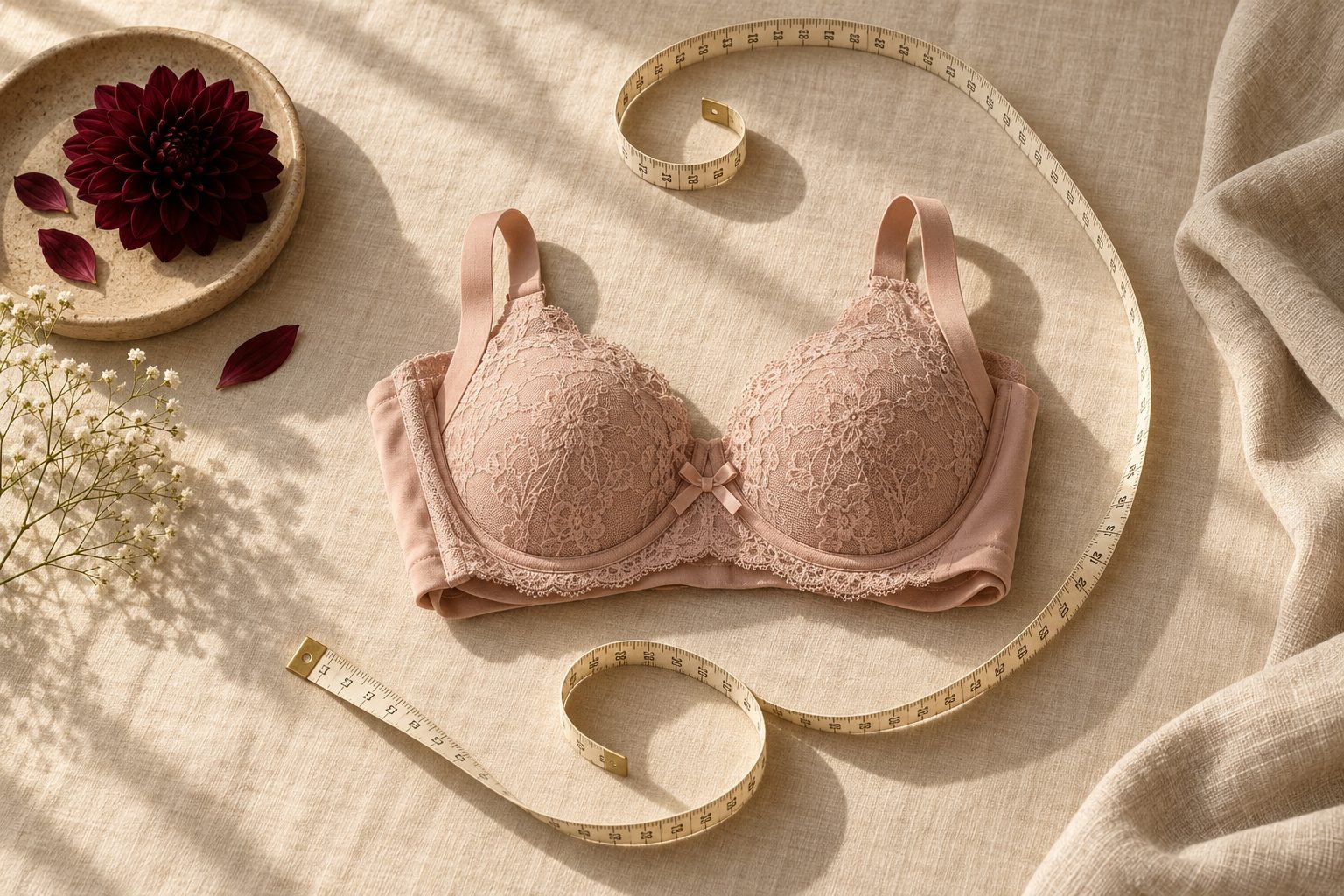
You need two measurements and about three minutes. Measure your underbust snug around the ribcage for the band size, then measure around the fullest part of your bust for the cup, and subtract the first from the second. That difference, in inches, is your cup letter.
The method matters more than the arithmetic, because most people take the underbust measurement too loosely and end up in a band that is one or two sizes too big. That single error is behind most of the fit problems people describe.
What you need
- A soft measuring tape, ideally with inches and centimetres on opposite sides. A rigid tape measure will not follow your ribcage.
- A mirror, so you can check the tape is level at the back.
- An unpadded bra, or no bra. Never measure over padding.
- A notebook or your phone, because you will take four numbers and you will not remember them.
As an Amazon Associate I earn from qualifying purchases. Product links below are affiliate links and we may earn a commission at no extra cost to you.
If you do not own a soft tape, this is the one item worth buying before you start:
iBayam 2-Pack Body Measuring Tape, 60 inch

Brand: iBayam
Best for: the tape itself
A double-sided soft tape with inches and centimetres on opposite edges, sold as a pair. The flexible body is the important part: it follows the ribcage instead of bridging across it, which is what produces an accurate underbust reading.
Rated 4.8 out of 5 from 53,206 ratings on Amazon, checked 9 November 2026.
Step 1: the underbust measurement
Stand in front of a mirror and wrap the tape around your ribcage, directly under the bust, where the band of a bra would sit. Keep it level all the way round. Pull it snug, tight enough that it does not slide down when you breathe out, and no tighter.
Breathe out normally and read the number. This is the measurement people get wrong, because a tape that sits loose feels more comfortable and gives a larger number.
Convert it: if the number is even, that is your band size. If it is odd, round to the nearest even number, up or down depending on which is closer. A 33 inch underbust is a 34 band. A 31 inch underbust is a 32 band.
Step 2: the bust measurement
Wrap the tape around the fullest part of your bust, usually level with the nipple, keeping it parallel to the floor and not pulling it tight. This measurement should sit against the skin without compressing anything.
Take it twice: once standing, and once leaning forward at about 45 degrees with the tape held level. If the two numbers differ by more than an inch, average them. Breasts that sit lower on the chest wall read differently standing and leaning, and the average is the better fit.
Step 3: the subtraction
Subtract the underbust from the bust. The difference in inches gives the cup:
| Difference, inches | Cup |
|---|---|
| 1 | A |
| 2 | B |
| 3 | C |
| 4 | D |
| 5 | DD (US) / E (UK) |
| 6 | DDD (US) / E (UK) |
| 7 | G (US) / F (UK) |
| 8 | H (US) / FF (UK) |
Letters do not mean the same thing in every country. Our bra size chart has the full US, UK and EU conversion including band sizes.
Step 4: check it against a bra you own
Take a bra that fits reasonably well and lay it flat. Measure the band from the hook to the eye when stretched slightly. It should be close to your underbust measurement. If it is two inches longer, the bra has stretched, and that is often the real reason a bra that used to fit now slides around.
What a correct fit feels like
| Check | What correct looks like |
|---|---|
| Band | Level all the way round, firm on the loosest hook, no more than two fingers of slack at the back |
| Gore | The centre piece lies flat against your sternum |
| Wire | Under breast tissue, not on it, along its whole length |
| Cups | No overflow at the top or sides, no gaping when you lean forward |
| Straps | Flush against the skin without pressing a groove into the shoulder |
If the band passes but the cups gap, the cup shape is wrong rather than the size. If the gore floats and the cups overflow, the cup is too small. Both are covered in our guide to cups that gap or wrinkle.
When to measure
- Not during your period. Breast volume and ribcage can both change by up to a cup size in the days before it.
- In the morning rather than the evening, when you are not yet swollen from the day.
- Every six months, and after any weight change of five pounds or more.
- Before buying from a brand you have not worn before, because sizing varies between them.
Common questions
Can I measure myself accurately?
Yes for the underbust, which is the one that matters most. The bust measurement is slightly easier with help, which is why the standing and leaning average is worth doing.
My two measurements give a size that does not fit. Why?
Usually because the cup shape does not match your breast shape, or because the band is being worn too loose and the straps are compensating. Try the sister size, one band down and one cup up, before deciding the measurement is wrong.
What if one breast is larger than the other?
Normal, and almost universal. Size for the larger side and use a small insert on the smaller side if the difference is visible. Our guide to bras for asymmetrical breasts covers it in more detail.
Do I need a professional fitting?
It helps, particularly above a DD cup, but it is not necessary. The measurements above, checked against a bra you already own, get most people to the right size.
The short version
Snug underbust for the band, rounded to the nearest even number. Fullest bust for the cup, averaged between standing and leaning. Subtract, and read the difference off the table. Then trust the fit checks over the number, because a size is only useful if the bra passes them.